
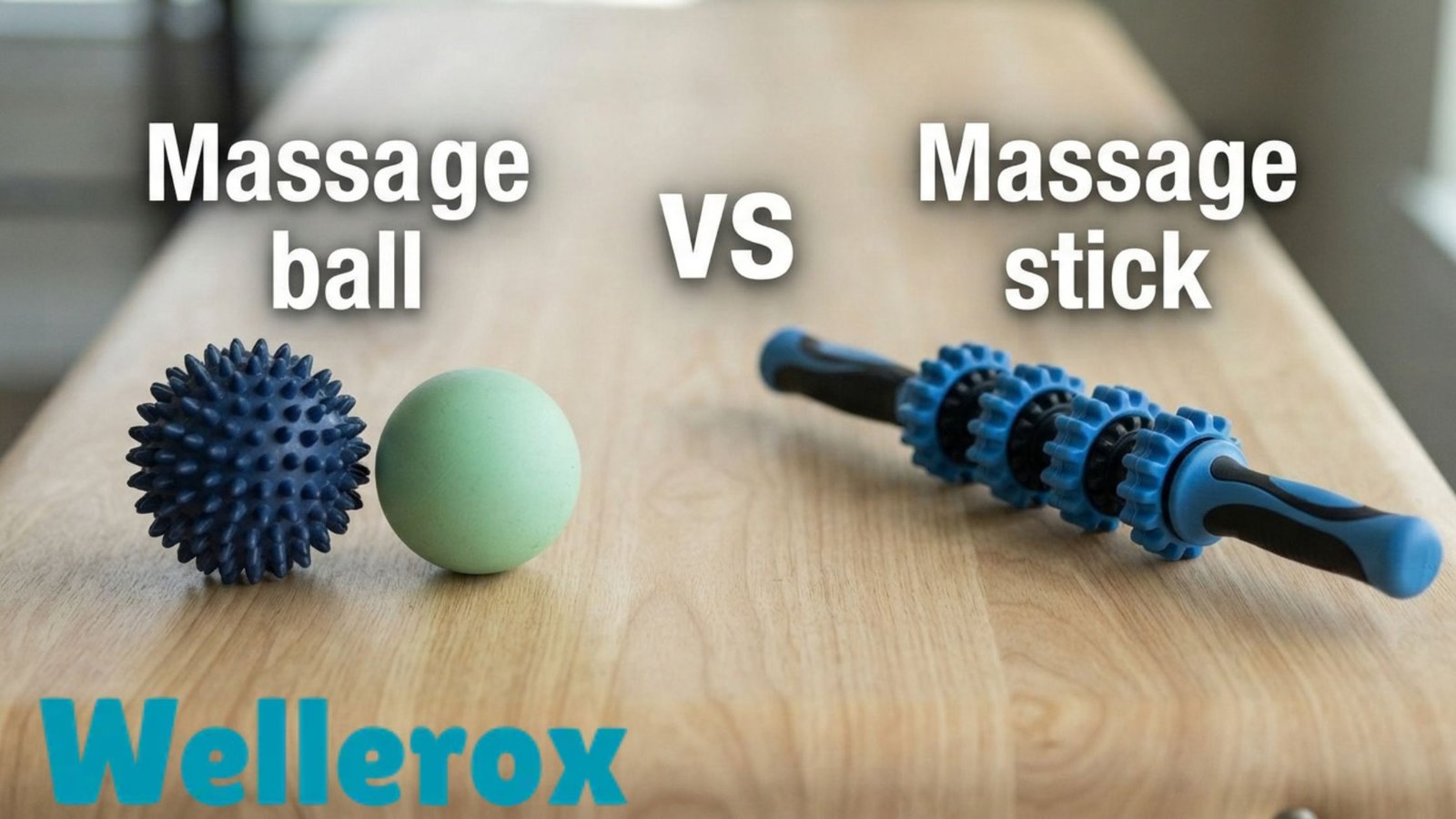
Both tools promise relief for tight, achy muscles, and both cost less than a single sports massage. They work in different ways, though, and the right pick depends on where you hurt, how you train, and how much control you want over the pressure.
Massage ball
Small, dense, and precise. You lean your body weight into it to work a specific knot in the glutes, feet, shoulders, or upper back.
Massage stick
A rod with rolling spindles that you hold with both hands. You control the pressure with your arms and sweep it along long muscles like the calves and quads.
How each tool works
A massage ball relies on your body weight. You place it between a muscle and the floor or a wall, then shift your weight to press into a tender spot. Because the contact point is small, the pressure is concentrated, which makes a ball good at finding and holding a single stubborn trigger point.
A massage stick works the other way around. You stay seated or standing and push the stick into the muscle with your hands. The rolling spindles spread pressure across a wider strip of tissue, so it feels more like a broad, flushing stroke than a pinpoint press.
Researchers generally group both under “self-myofascial release,” and studies on foam rollers and roller sticks suggest short-term gains in range of motion and a reduced feeling of soreness after exercise. The evidence on long-term performance benefits is less settled, so it’s fair to treat either tool as a comfort and mobility aid, with any bigger promises taken loosely.
Massage ball: strengths and limits
The biggest strength of a massage ball is precision. It reaches places a stick can’t, such as the arch of the foot, the space between the shoulder blades, the piriformis deep in the hip, and the pecs near the armpit.
Where a ball shines
- Feet: rolling a ball under the arch for 1 to 2 minutes is a common routine for people who stand all day or run often.
- Glutes and hips: sitting on a ball lets your body weight do the work in areas that are hard to press by hand.
- Upper back and shoulders: leaning a ball against a wall targets the muscles around the shoulder blades.
- Travel: a ball weighs very little and fits in a jacket pocket.
Where a ball falls short
Because body weight drives the pressure, a ball can feel too intense on sensitive areas, and it’s awkward to use on the front of the thighs or the shins. It also takes some floor or wall space and a bit of balance to position yourself, which isn’t ideal if you have limited mobility.
Balls come in several types. A firm lacrosse-style ball gives deep pressure, a softer rubber ball is gentler for beginners, a spiky ball adds texture for the feet, and a peanut-shaped double ball lets you roll either side of the spine without pressing on the bones themselves.
Massage stick: strengths and limits
A massage stick gives you hand control. You can ease off instantly if something feels sharp, which makes it friendlier for beginners, older adults, and anyone working around a sore spot that can’t take full body weight.
Where a stick shines
- Calves and shins: long, steady strokes work well along the lower leg, a favorite area for runners and hikers.
- Quads and hamstrings: you can roll the thighs while seated without getting down on the floor.
- IT band area: you can apply gentler, more controlled pressure along the side of the thigh than a foam roller allows.
- Quick warm-ups: a 30-second pass over each leg before a run or a game is easy to do standing up.
Where a stick falls short
Sticks struggle with the back, since you can’t reach most of it with both hands on the handles. They’re also less precise on knots, and your arms can tire if you’re working large areas for several minutes. At 40 to 60 cm long, they pack less neatly than a ball.
Side-by-side comparison
| Feature | Massage ball | Massage stick |
|---|---|---|
| Pressure source | Body weight | Arm strength |
| Pressure control | Moderate, takes practice | High, adjusts instantly |
| Best areas | Feet, glutes, hips, upper back, shoulders | Calves, shins, quads, hamstrings |
| Precision | High, targets single knots | Lower, covers broad strips |
| Floor needed? | Usually, or a wall | No |
| Portability | Pocket-sized | Fits in a gym bag |
| Typical price | Low; many sell for under $25 | Low to moderate; many sell for $20 to $50 |
Prices vary widely by brand and material, so treat the figures above as a rough guide and check current listings before you buy.
Which should you choose?
Choose a massage ball if
- Your tight spots are in your feet, hips, glutes, or upper back.
- You want to work deep, specific knots.
- You travel often and need something tiny.
- You sit at a desk and get stiffness between the shoulder blades.
Choose a massage stick if
- You’re a runner, cyclist, or hiker whose legs take the most punishment.
- You want fine control over how hard you press.
- Getting down on the floor is difficult or uncomfortable.
- You prefer a quick standing routine before or after exercise.
Plenty of people end up owning both. The combined cost is modest, and each tool covers the other’s blind spots: the ball handles the back and feet, and the stick handles the legs.
Using them on the road and on the trail
Travel is where a ball earns its spot. Long flights and hours in a car tighten the hips and lower back, and a ball tucked into a carry-on lets you work those areas in a hotel room. If you’re flying into San Francisco and staying at one of the Daly City hotels near the airport, 10 minutes on the floor with a ball after landing can make the next day of sightseeing a lot more comfortable.
Multi-day hikes call for a different setup. On a long route like the Annapurna Circuit Trek, your calves and quads do most of the work through steep climbs and long descents. Trekkers watching every gram usually pack a ball, since it’s lighter, but a short travel-length stick is worth considering if your legs are the main concern and you have room in a duffel carried by a porter or pack animal.
Storing them in a home gym
Neither tool needs much room, which is part of the appeal. A ball can sit in a drawer or basket, and a stick can hang from a hook or lean in a corner. If you’re setting up a dedicated workout area and want to fit recovery tools alongside weights and mats, a space planning guide can help you map out clearances so you still have floor room for ball work.
How to use each tool safely
- Start gentle. Use light pressure for the first few sessions and build up as your tissue gets used to it.
- Keep sessions short. Around 30 seconds to 2 minutes per area is a common recommendation.
- Avoid bones and joints. Roll muscle tissue only, and skip the spine, kneecap, and the front of the neck.
- Breathe and relax. Tensing up against the pressure makes it less effective and more uncomfortable.
- Stop if it hurts sharply. Mild discomfort is normal, while sharp, shooting, or numbing pain is a signal to stop.
If you have a recent injury, a blood clotting condition, varicose veins, or you’re pregnant, check with a doctor or physical therapist before using either tool. This article offers general information and isn’t medical advice.
The bottom line
A massage ball is the better pick for precise, deep work on the feet, hips, and back, and it’s the easiest tool to carry anywhere. A massage stick suits people who mostly need relief in their legs and want full control over the pressure without getting on the floor. If your aches are spread across your body, buying one of each is an affordable way to cover everything.
Frequently asked questions
Is A Massage Ball Better Than A Massage Stick?
A massage ball is better for small, deep knots in the feet, hips, and back, while a stick is better for long leg muscles.
Can I Use A Massage Ball On My Back?
Using a massage ball on your back works well against a wall or the floor, as long as you stay on the muscles beside the spine.
Is A Massage Stick Good For Runners?
A massage stick is popular with runners because it covers the calves, shins, and quads quickly.
How Long Should I Use A Massage Tool On Each Muscle?
About 30 seconds to 2 minutes per area is a common guideline.
Can I Use These Tools Every Day?
Daily use is generally fine at gentle to moderate pressure, as long as you’re not working an injured area.
COMMENTS