
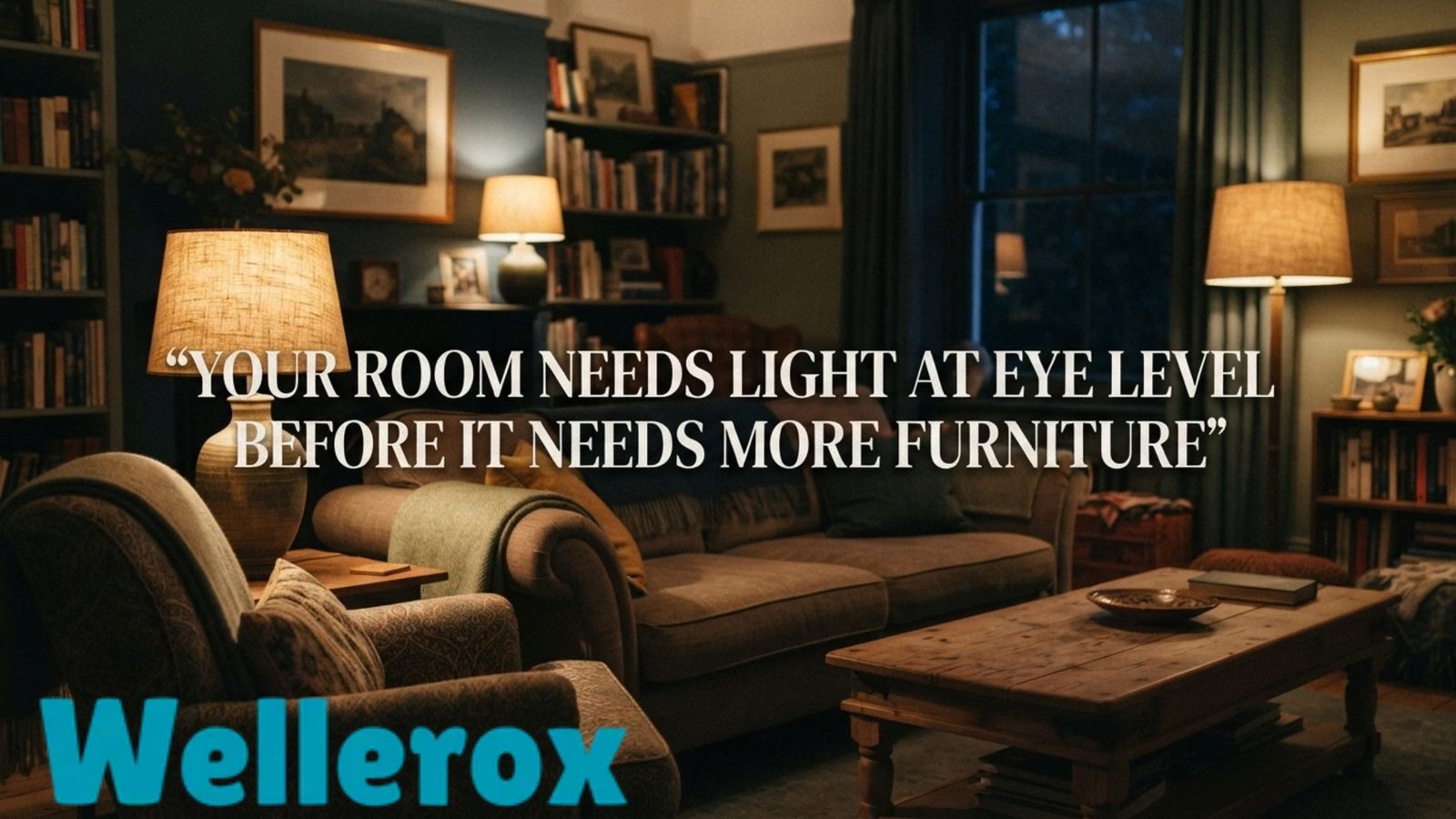
Then the ceiling fixture burned out one evening, and I lit the place with 2 table lamps and a candle. And for the first time, the room looked like the room I’d been trying to buy my way into.
The problem was where the light came from.
Why overhead light makes a room feel empty
Most homes get one ceiling fixture per room, maybe a grid of recessed cans. That light drops straight down onto floors and tabletops. Walls stay dim, corners go grey, and faces pick up shadows under the eyes.
You read a room from about 5 feet off the ground. That’s where you look at people, art, the view out a window. When nothing is lit at that height, the space feels sparse no matter how much furniture you pack in.
(Adding furniture to a badly lit room is like adding words to a bad sentence. More stuff, same problem.)
What light at eye level actually means
It means light sources sitting roughly 4 to 6 feet off the floor. Table lamps on a console, floor lamps with real shades, picture lights, and wall-mounted fixtures all count.
Of those, wall sconces do the heaviest lifting. They throw light directly onto the wall surface, and a lit wall makes a room read as bigger and warmer at the same time. They also don’t eat floor space, which matters a lot in small rooms.
A lit wall does more for a room than a new sofa. I’d bet money on that.
Where sconces make the biggest difference
Living rooms
Put a pair on either side of a fireplace, a sofa, or a big piece of art. Most designers mount them so the center of the fixture sits around 60 to 66 inches off the floor. Pick fixtures that bounce light up and down the wall, and you get that soft wash that makes plaster look expensive.
Hallways
Hallways are usually the darkest spot in the house, and the one with the worst ceiling light. One sconce every 8 to 10 feet fixes it. The walk to the bathroom at night stops feeling like a tunnel.
Bedrooms
Swing-arm sconces beside the bed clear your nightstand for the stuff you actually keep there (a glass of water, 3 half-read books, a charger). I like the bottom of the shade about 20 inches above the top of the mattress, but sit up in bed and test it with tape first. Everyone reads at a slightly different height.
Bathrooms
This is where overhead light does the most damage. A single fixture above the mirror shades your eye sockets and chin, which is a rough way to start the morning.
Mount one sconce on each side of the mirror, around 66 inches high and 30 to 40 inches apart. Light hits your face from both sides and the shadows disappear.
If you’re redoing the shower too, clear glass helps the whole room. Installers who do Frameless Shower Doors in Phoenixville, PA drop the metal frame entirely, so light from the vanity carries all the way to the back tile. A small bathroom suddenly reads as one room.
Closets and dressing areas
Ever pulled on what you thought was a black sweatshirt and walked outside to find it’s navy? Blame the closet bulb.
A sconce or 2 next to a full-length mirror shows color honestly. That matters more than you’d think when half your wardrobe is the same muted grey, oatmeal, and charcoal, like the neutral sets from Essentials Clothing. Tonal outfits only work when you can see the tones.
Getting the bulb right
The fixture matters less than what’s inside it. A few numbers to shop by:
Color temperature: 2700K to 3000K for living spaces and bedrooms. Anything above 3500K starts to feel like an office.
Color rendering (CRI): 90 or higher. Cheap LEDs at CRI 80 make skin look grey and wood look green.
Brightness: roughly 300 to 500 lumens per sconce for mood lighting, closer to 800 per side at a bathroom mirror.
And put them on dimmers if you can. A sconce at 40% after dinner is probably the best thing that ever happened to my living room.
Hardwired or plug-in?
Plug-in sconces are the renter’s answer. They hang on a screw or two, the cord runs down to an outlet, and a paintable cord cover hides most of it. You can install one in 15 minutes.
Hardwired sconces look cleaner but need a junction box in the wall and an electrician. Cost swings a lot by region and wall type, so get 2 quotes.
The cheapest time to add them is while the walls are open. If you’re building an addition or a backyard unit, plan sconce boxes at the framing stage. The ADU build process on the Remodel Works Bath & Kitchen Design of San Diego site is a good example of how design-build teams lay out electrical early, so the boxes land where the bed and sofa will actually go. Small units especially need this. In a 600-square-foot ADU, every recessed can you skip frees up budget for a pair of sconces.
Sconces will show you every crack
Here’s a side effect I didn’t expect. Light that grazes a wall from the side picks up every bump, patch, and crack the flat overhead light used to hide.
Most of it is cosmetic. Hairline lines along drywall seams or nail pops are normal settling, and a little mud and paint fixes them.
Some cracks deserve a closer look, though. Diagonal cracks running from the corners of doors and windows, stair-step cracks in brick, doors that suddenly stick, gaps that keep getting wider month to month. Those can point to foundation movement.
Coastal towns with sandy, wet soil see this a lot. Homeowners there often end up searching for the Best Foundation Repair in Wilmington, NC once a crack keeps growing. Wherever you live, if a crack gets wider, get a structural inspection before you hang anything on that wall.
Try this before you buy anything
Tonight, switch off the overhead light. Grab every lamp you own and get the bulbs up to roughly shoulder height (stack books under them if you have to). Sit in the room for 20 minutes.
If it feels better, and I’m pretty sure it will, you know what to spend on next. It probably isn’t another chair.
Frequently asked questions
How High Should Wall Sconces Be Mounted?
Wall sconces usually go 60 to 66 inches from the floor to the center of the fixture. Bathroom sconces sit closer to 66 inches so the light lands at face height.
Can Wall Sconces Replace Ceiling Lights?
Sconces can light a small room on their own. Larger rooms usually need them paired with lamps or a dimmed ceiling fixture.
What Color Temperature Works Best at Home?
Warm white bulbs between 2700K and 3000K suit living rooms, bedrooms, and hallways. Look for a CRI of 90 or higher.
Do I Need an Electrician to Install Sconces?
Hardwired sconces need an electrician in most cases. Plug-in models only need a nearby outlet and a couple of screws.
How Far Apart Should Bathroom Sconces Be?
Bathroom sconces typically sit 30 to 40 inches apart, one on each side of the mirror.
Visit Main Page: wellerox
COMMENTS